DOP 307: Kubernetes in 2025
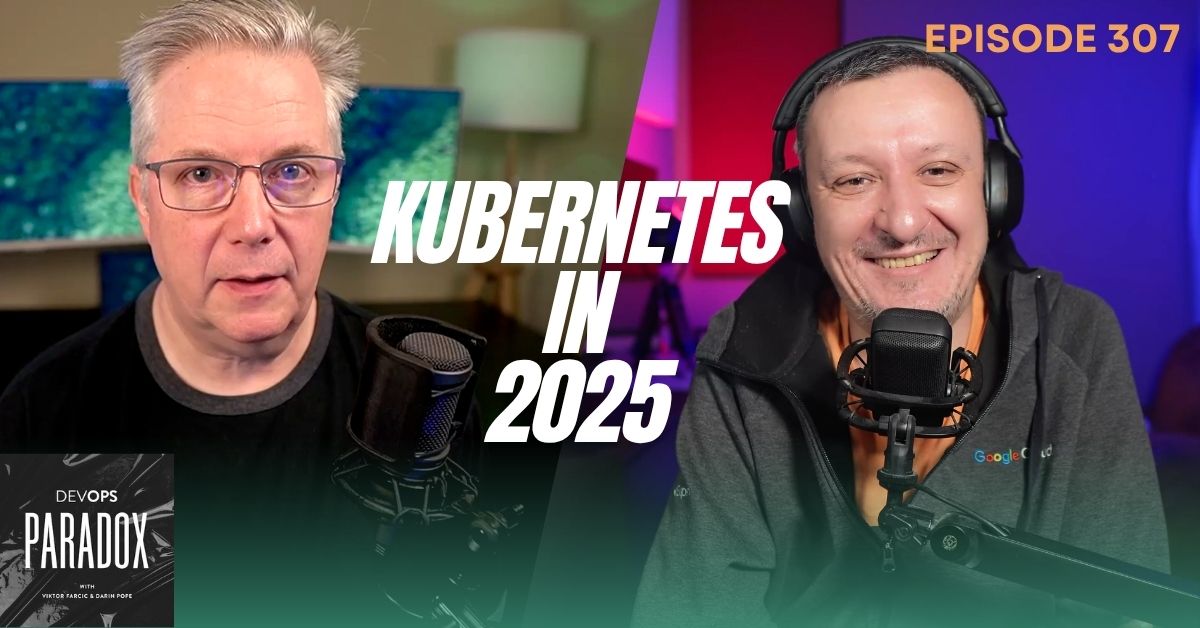
Episode 307
DOP 307: Kubernetes in 2025

Show Notes

#307: In this episode, Darin and Viktor discuss a blog post from Fairwinds about Kubernetes in 2025. Key topics include the ongoing rise in Kubernetes and Docker adoption, the future of container use, Kubernetes use cases, developer sentiment towards Kubernetes, and predictions on container management, multi-cloud strategies, and the role of AI in DevOps. They also touch on the importance of resource optimization over purely cost optimization and the expected consolidation of Kubernetes clusters for better efficiency. The discussion offers a perspective on the Fairwinds predictions, with a particular focus on the practical aspects of Kubernetes deployment and management.

Frequently Asked Questions

Should developers be given direct access to Kubernetes?

Viktor Farcic is emphatic on DevOps Paradox episode 307: “Nobody should give developers Kubernetes as is”. Handing over a kubeconfig makes their work harder rather than more productive. Kubernetes is the base you build a platform on, or the thing you skip in favour of a service that already did it. It took him years to master, and he does not expect everyone else to stop what they are doing and match that.

Do developers want managed Kubernetes?

Viktor Farcic argues on DevOps Paradox episode 307 that they want not to see Kubernetes at all, and that whether the cluster is managed makes no difference to them. His benchmark is the deployment experience Heroku set nearly two decades ago: supply the information that matters, get the result you expect. His analogy for the right outcome is the hypervisor, which most people neither see nor can name.

Is it cost optimization or resource optimization?

Viktor Farcic objects to the usual name on DevOps Paradox episode 307. What teams actually do is work out how much memory and CPU a workload needs and adjust to match, which is resource optimisation. Lower cost is a side effect and is not guaranteed, since the correct answer might be more. He acknowledges why the other name persists: nobody buys resource optimisation, and everybody buys cost reduction.

Why consolidate Kubernetes clusters?

Viktor Farcic gives two reasons on DevOps Paradox episode 307. Each cluster needs its own control plane nodes, so a hundred clusters means hundreds of nodes running nothing of yours. Larger nodes in fewer clusters also let schedulers pack workloads more efficiently. He adds a cause for the sprawl: handing a team a fresh cluster feels safer than trusting isolation within an existing one, which is fear rather than design.

Is multi-cloud worth pursuing?

Viktor Farcic expects that ambition to fade on DevOps Paradox episode 307, on the grounds that running across several providers is expensive on many levels and rarely justified as a design choice. He distinguishes it from hybrid, where on-premises plus cloud has real reasons: existing hardware, cloud for peak load, or one service a provider genuinely does better. Multi-cloud usually arrives through acquisition rather than intention.

What should AI actually do for operations?

Viktor Farcic sets a higher bar than anomaly detection on DevOps Paradox episode 307. Asking what is wrong with your pods is useful but not the goal. He wants something that learns from what he did: having watched him restart a particular pod five times, it should handle the sixth and only call him when the outcome differs, the same expectation he would have of an intern.

What is the DevOps Paradox podcast?

DevOps Paradox is a weekly podcast co-hosted by Darin Pope and Viktor Farcic, covering DevOps, platform engineering, and modern software delivery. Episode 307 works through a set of published Kubernetes predictions for 2025, agreeing with some and taking apart others on developer experience, cluster consolidation, multi-cloud and what to call resource optimisation. Every episode page carries the audio, the video, and a full transcript.

Topics

Share and Download

Hosts

Viktor Farcic

Viktor Farcic

Viktor Farcic is a member of the Google Developer Experts and Docker Captains groups, and published author.

His big passions are DevOps, Containers, Kubernetes, Microservices, Continuous Integration, Delivery and Deployment (CI/CD) and Test-Driven Development (TDD).

He often speaks at community gatherings and conferences.

He has published DevOps Paradox and Test-Driven Java Development.

His random thoughts and tutorials can be found in his blog The DevOps Toolkit.